

Overview
- Key Takeaways
- What Is the BMI Formula?
- How to Calculate BMI in Metric Units
- How to Calculate BMI with Pounds and Inches
- Common BMI Calculation Mistakes
- What Do BMI Numbers Mean for Adults?
- Why Is BMI Used?
- What BMI Does Not Measure
- Practical Recommendations
- How Nucore Health Can Help
- Frequently Asked Questions
How Is BMI Calculated? Formula and Examples
 Written by the Nucore Health Clinical Team
Published on 11-18-2026
Key Takeaways
- BMI is a screening number calculated from height and weight. It is not a diagnosis or a complete description of health.
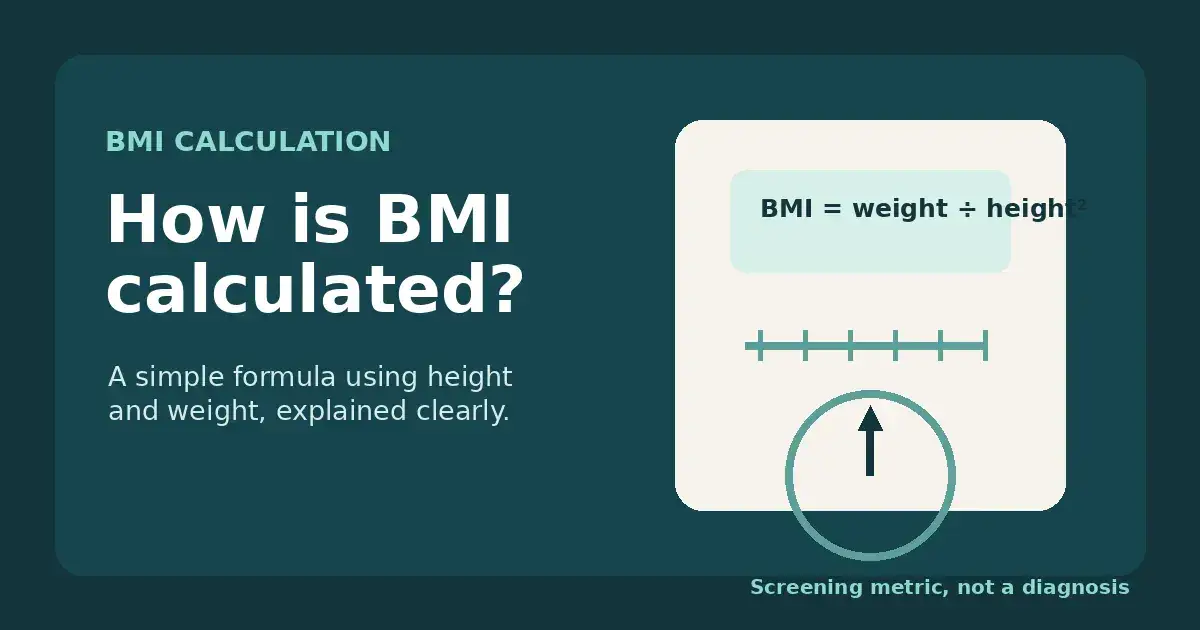
- Metric BMI equals weight in kilograms divided by height in meters squared. The U.S. formula is weight in pounds divided by height in inches squared, then multiplied by 703.
- Convert feet and inches to total inches before using the U.S. formula. Five feet 10 inches is 70 inches, not 5.10.
- For adults age 20 and older, common screening ranges are below 18.5, 18.5 to 24.9, 25.0 to 29.9, and 30.0 or higher.
- BMI does not measure body fat, muscle, fitness, or overall health. A clinician may look at other measurements before suggesting any next step.
Body mass index, or BMI, is a number calculated from your weight and height. It is often used as a quick screening measure to place adults into broad weight categories. If you are checking a result from a calculator, understanding the formula can help you see where the number came from and what it does—and does not—mean.
Start with the BMI calculation tool to enter your measurements, then use the steps below to verify the result.
What Is the BMI Formula?
The formula depends on the units you use:
- Metric: BMI = weight in kilograms ÷ (height in meters × height in meters)
- U.S. customary units: BMI = [weight in pounds ÷ (height in inches × height in inches)] × 703
The factor 703 converts the pounds-and-inches calculation so it is comparable with the metric version. If your height is in feet and inches, convert it to total inches before using the U.S. formula. For example, 5 feet 10 inches is 70 inches.
How to Calculate BMI in Metric Units
For a metric calculation, you need weight in kilograms and height in meters. If your height is given in centimeters, divide it by 100 first.
Metric example
Imagine an adult who weighs 82 kilograms and is 1.75 meters tall:
BMI = 82 ÷ (1.75 × 1.75)
BMI = 82 ÷ 3.0625
BMI ≈ 26.8
The result is rounded to one decimal place for easier reading. Keeping more decimal places during the calculation and rounding only at the end helps avoid small differences between calculators.
How to Calculate BMI with Pounds and Inches
For U.S. measurements, use your weight in pounds and your height in inches. Square the height, divide the weight by that number, and then multiply by 703.
U.S. units example
Imagine an adult who weighs 180 pounds and is 5 feet 10 inches tall:
First, convert the height: 5 feet 10 inches = 70 inches.
BMI = (180 ÷ (70 × 70)) × 703
BMI = (180 ÷ 4,900) × 703
BMI ≈ 25.8
This is the same basic calculation a BMI calculator performs when you enter pounds, feet, and inches.
Common BMI Calculation Mistakes
Small input errors can change the result, especially when height is entered incorrectly. Before comparing your number with a category, check these details:
- Convert feet and inches correctly: multiply the number of feet by 12, then add the remaining inches. Do not enter 5.10 for 5 feet 10 inches; that is a decimal value, not a total-inch measurement.
- Use the right weight unit: pounds belong in the U.S. formula, while kilograms belong in the metric formula. Mixing units can produce a very different result.
- Square height before dividing: the denominator is height multiplied by itself. It is not weight divided by height and then multiplied by 2.
- Round at the end: retain a few decimal places while calculating, then round the final result to one decimal place.
A calculator can reduce arithmetic mistakes, but it cannot decide whether BMI is an appropriate measure for your specific circumstances. If you are tracking weight changes, use the same units and a consistent measurement approach so results are easier to compare over time.
What Do BMI Numbers Mean for Adults?
For adults age 20 and older, the standard categories are commonly interpreted as:
| BMI range | Category |
|---|---|
| Below 18.5 | Underweight |
| 18.5 to 24.9 | Healthy weight |
| 25.0 to 29.9 | Overweight |
| 30.0 or higher | Obesity |
These ranges are screening categories, not a diagnosis or a complete description of your health. The Centers for Disease Control and Prevention explains adult BMI categories and their limitations.
Why Is BMI Used?
BMI requires only two measurements that are generally easy to obtain: height and weight. That makes it useful for screening large groups of people and for giving a clinician a starting point for further questions. A single BMI result does not establish a cause of weight change or tell you which care plan, if any, is right for you.
For a more complete picture, a healthcare professional may consider waist measurement, blood pressure, laboratory results, medical history, medications, nutrition, activity, sleep, and how you feel.
What BMI Does Not Measure
BMI uses only height and weight. It does not directly measure body fat, muscle mass, bone density, waist size, fitness, diet, or overall health. For example, someone with a higher amount of muscle may have a higher BMI without having the same body-fat pattern as someone with less muscle. BMI can also be less informative when considered without age, sex, family history, medications, and other health factors.
BMI is interpreted differently for children and teens, who are assessed using age- and sex-specific growth-chart percentiles. It should not be used by itself to evaluate pregnancy, and a clinician may recommend other measurements or assessments depending on your situation.
Practical Recommendations
Use BMI as a starting point for a broader conversation, not as a verdict about your body or your health. If your result surprises you, check that your height and weight were entered in the correct units and that your height was converted correctly.
- Use the same units each time you compare results.
- Convert feet and inches to total inches before using the U.S. formula.
- Round only the final result, and keep it to one decimal place.
- Talk with a qualified healthcare professional before changing a weight-management plan, especially if you have a medical condition, take prescription medication, or are pregnant.
How Nucore Health Can Help
If you are exploring clinician-guided options for weight management, you can learn more about online GLP-1 treatment information, including the need for clinical review and approval.
Nucore Health’s online tools are informational. Treatment decisions, if appropriate, require review and approval by an independent licensed clinician.
Want to learn more and check your numbers? Use the BMI calculation tool for an informational estimate, then use the result as one piece of a larger health conversation.
The Bottom Line
BMI is a simple calculation from height and weight, and the formula changes with the units you use. The number can place an adult into a broad screening category, but it does not measure body fat, muscle, fitness, or overall health, and it is not a diagnosis. Check the units, then treat the result as one piece of a larger conversation with a qualified healthcare professional.
Frequently Asked Questions
What is the BMI formula?
In metric units, divide weight in kilograms by height in meters squared. In U.S. units, divide weight in pounds by height in inches squared, then multiply by 703.
How do I convert feet and inches for BMI?
Multiply the feet by 12 and add the remaining inches. Five feet 10 inches is 70 inches. Do not enter 5.10, because that is a decimal, not a total-inch measurement.
What do adult BMI ranges mean?
For adults age 20 and older, common screening categories are below 18.5, 18.5 to 24.9, 25.0 to 29.9, and 30.0 or higher. These are screening categories, not a diagnosis.
Does BMI measure body fat?
No. BMI uses only height and weight. It does not directly measure body fat, muscle mass, bone density, waist size, fitness, diet, or overall health.
Should I use BMI during pregnancy or for a child?
BMI should not be used by itself to evaluate pregnancy. Children and teens are assessed with age- and sex-specific growth-chart percentiles, not the adult categories.
Sources
1. Centers for Disease Control and Prevention — About Adult BMI
Medical Disclaimer
This article is for educational purposes only and is not intended as, and should not be interpreted as, individualized medical advice, diagnosis, or treatment. BMI is a screening measure, and appropriate next steps vary from person to person. Always consult a qualified healthcare provider regarding your specific health concerns before making any changes to your care. Nucore Health’s online tools are informational. Treatment, if appropriate, requires review and approval by an independent licensed clinician.